Showing posts with label The Third Class. Show all posts

Saturday, February 6, 2016

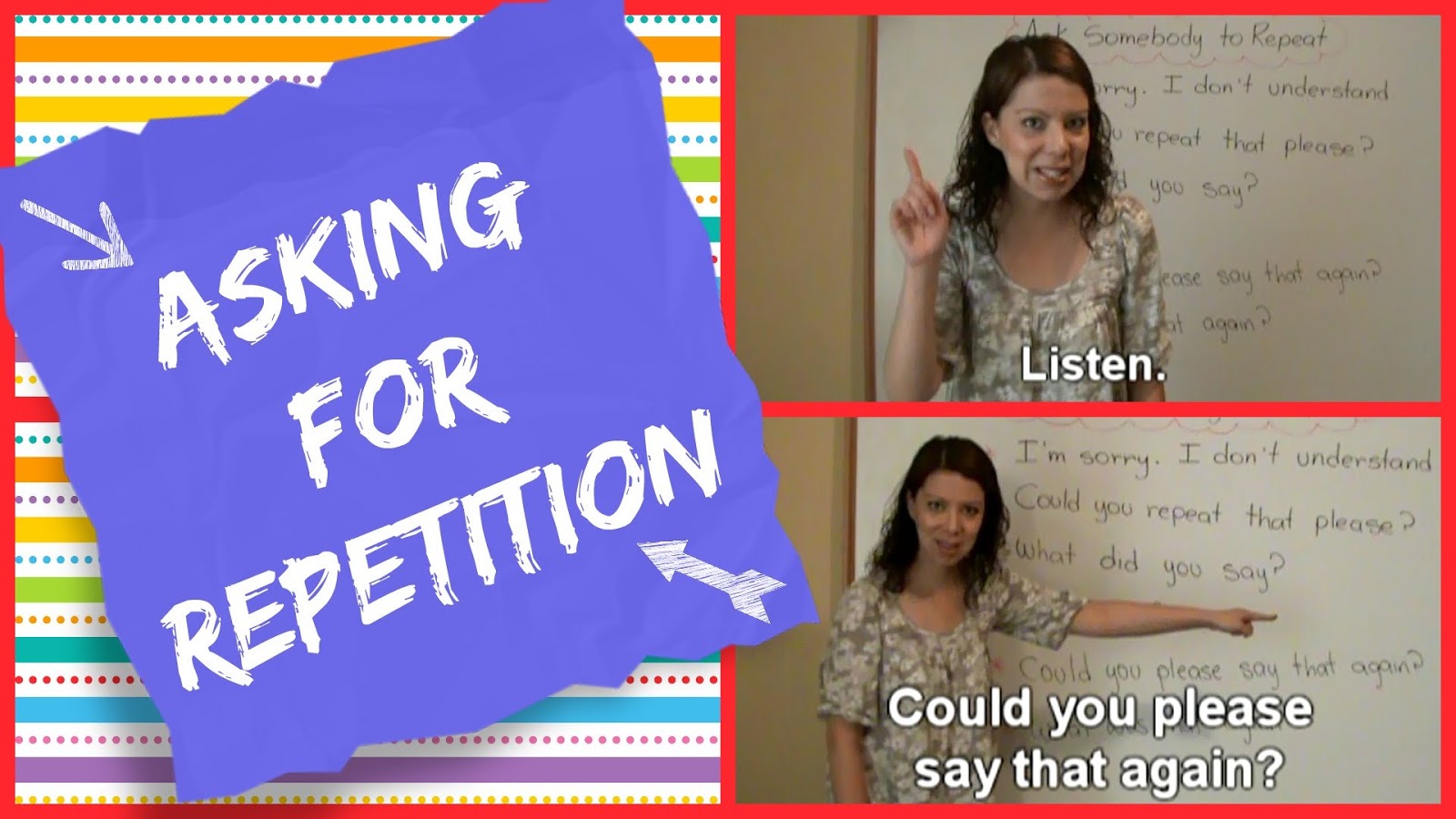
Asking for Repetitions
Asking for Repetitions

Read the dialog
Tina : We will get off in some minutes. We almost reach my house.
Jane : Pardon? What did you say?
Tina : We will reach our house in some minutes.
Jane : Really? Thanks God

The sentence "Pardon? What did you say?" is an expression to ask for a repetition. You usually ask for repetitions when you don't hear or can't hear clearly what someone had said. When you ask someone to repeat his/her words, you should do it politely.

The following are some expressions to ask for repetitions and their responses
Asking for Repetitions
  • Sorry. Can you repeat your words, please?
  • Could you please repeat that?
  • Could you say that again, please?
  • I beg your pardon. Would you mind repeating your words?
  • Excuse me. Could you please repeat the last instructions?
Responding
  • I told you that we will have a new teacher.
  • O.K.
  • Of course.
  • All right.
  • Sure.

Friday, February 5, 2016

Asking for and Showing Certainty

Asking for and Showing Certainty


Read the following dialog.
Tommy : Uncle Joe's family will visit us next week.
Jane     : Is it confirmed?
Tommy : Absolutely! He just phoned me about it.

The sentence "Is it confirmed?" is an expression to ask for certainty. Meanwhile, the sentence "Absolutely!" is an expression to show certainty. You usually ask for certainty when you are not sure about something.

The following are some expressions to ask for certainty and to show certainty or uncertainty.
Asking for Certainty
  • Are you sure?
  • Are you certain?
  • Are you sure about it?
  • Is it confirmed?
  • Is that so?
  • Are you positive?
Showing Certainty
  • Yes. I'm sure.
  • Of course.
  • Without a doubt.
  • Yes. It is confirmed.
  • Sure. i'm certain.
  • I'm absolutely positive
Showing Uncertainty
  • I'm not sure.
  • I don't know for certain.
  • I'm not completely sure.
  • Not as far as I know.
  • I'm not certain.
  • I'm not a hundred per cent positive.

Thursday, February 4, 2016

Telling about Interesting News or Information and Responding to It

Telling about Interesting News or Information and Responding to It

Let read the following dialogs
Dialog 1.
Thomas : Did you hear that Anton was called to the principal's office again?
Andre : No way!
Thomas : It's true. He skipped school yesterday.
Andre : Why doesn't he learn from his past mistakes? His parents must be so sad.
Thomas : Yes. He has been told off before, but he doesn't seem to have changed.
Andre : Unfortunately, we can do nothing, right?
Thomas : Right


Dialog 2.
Jane : Tommy, I tried to find your name on the facebook, but I couldn't find it.
Tommy : Sorry, Jane. I don't have a facebook account.
Jane : What? I don't believe it. Almost everyone has it, you know.
Tommy : I don't think it gives me much benefits.
Jane : Let me tell you this. I have a facebook account. It enables me to make friends with people from abroad. So, I can improve my English.
Tommy : Is that so?
Jane : Yup!

In dialog 1, Thomas said, "It's true. He skipped school yesterday." to give information. Meanwhile, in dialog 2, Jane said "Let me tell you this. I have a facebook account. It enables me to make friends with people from abroad. So, I can improve my English." to tell about interesting news.

Here are some expressions to tell about interesting news or information and their possible responses.
Telling about Interesting News or Information.
  • Guess what!
  • Let me tell you this.
  • I'll tell you what!
  • I've got good news.
  • Have you heard the news?
  • Look at this! You won't believe it.
  • I've got hot news. Want to hear it?
Responding
  • You are terrific!
  • Is that true?
  • I can't believe it.
  • I'm glad to hear that.
  • I'm happy with the news.
  • I can feel that you're happy.
  • Really?
  • Wow!
  • Amazing
  • Wonderful!
  • That's great!

Sunday, January 31, 2016

Expressing Politeness

Expressing Politeness


Politeness is behaving in a way that is not rude and shows that you do not only think about yourself. Thus, we must be polite an we must express our politeness to others.

To make your request sounds polite, you may use the following words.

  • Please, at the beginning or the end of your sentence.
  • Modals, like can, will, could, would, may. Only use could and would in a formal situation or when you are talking with someone you haven't known before.

Here are some expressions used to express politeness and their possible responses.
Expressions of Politeness
  • Open the door, please.
  • Can you help me bring the books?
  • Will you accompany me to the library, please?
  • Excuse me, Where is the Principal's office?
  • Would you tell me where the Principal's office is, please?
  • Could you tell me where the Principal's office is?
  • Would you mind ...?
  • May I help you ...?
  • Could you please ...?
  • Would you please ...?
Responses
  • All right
  • With pleasure 
  • Certainly
  • Sure
  • Of course I would
  • I'd like to
  • Okay
  • No, thank you
  • I'm sorry, but ...
The text above is the example of the expressions of politeness. You may use those expressions when you talk with everyone.